Agentic AI, strong data and executive piloting

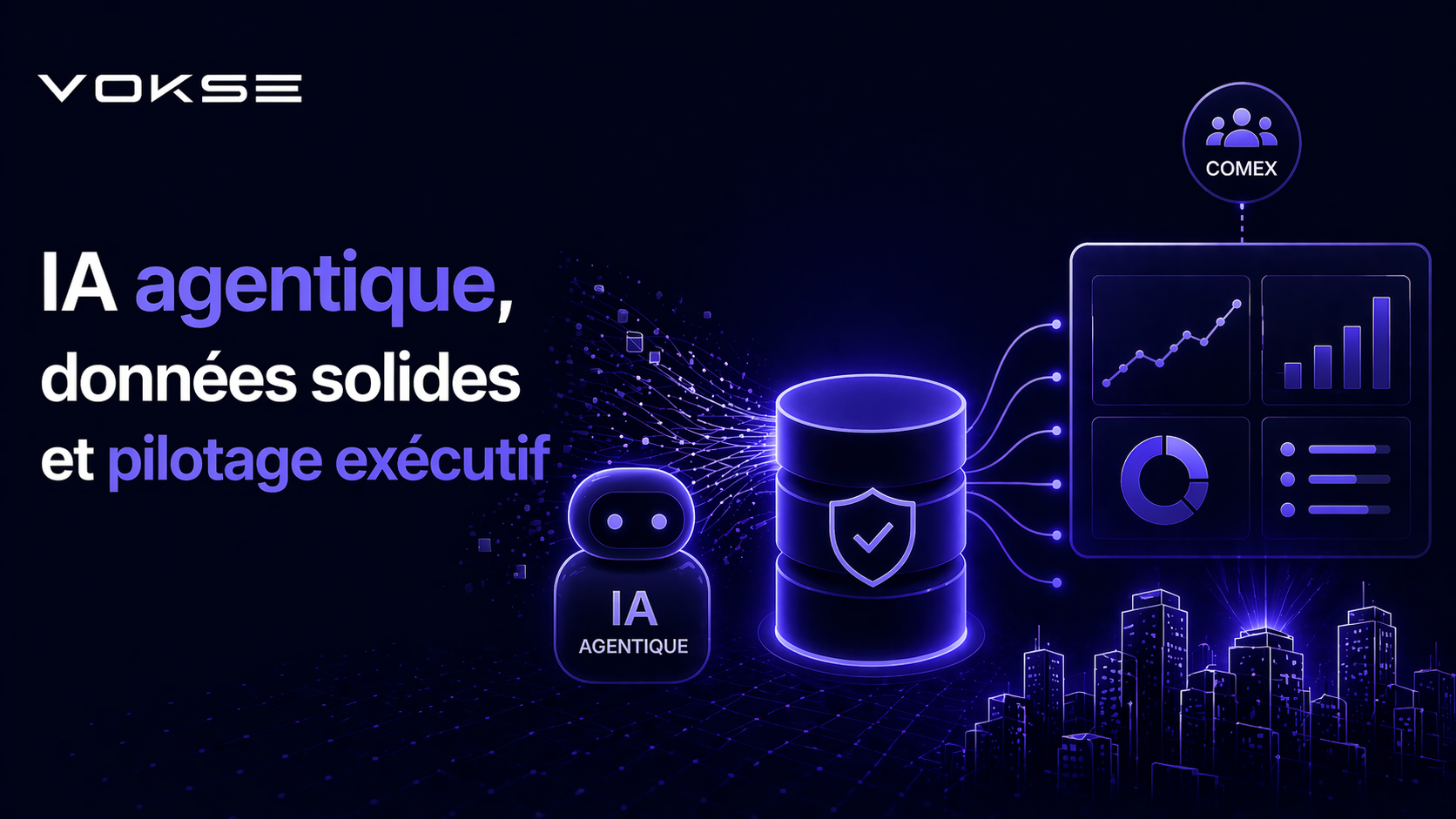
Why the ability to pilot is becoming a strategic issue for the executive committee
Reading a recent ZDNET article about scaling up agentic AI, one point particularly struck me. The article does not focus on models, prompts or compute power. It highlights a far more structuring topic for companies: the real solidity of data and the organization’s ability to pilot it.
This observation goes well beyond AI alone. It reveals a fragility that many executive committees already face. Companies govern their data, but still struggle to use it as a genuine lever for decision-making and execution.
Governing data is no longer enough — it must be piloted
For several years, organizations have multiplied governance mechanisms. Data catalogs, rules, committees, domain owners. These initiatives have improved compliance and transparency, but they often remain far from strategic decision-making.
“We had a very structured governance, but no clear answer when the executive committee asked what the real impact of a decision would be on our operations,” explains a Chief Data Officer at a media group.
“The data was compliant, but not pilotable.”
Data is documented, but rarely explained. Available, but hard to action. It serves more to comment on the past than to secure the future.
At the executive committee level, this gap becomes critical, especially when it comes to accelerated decisions, automation or agentic AI.
Strong data starts with decision-oriented quality
The ZDNET article stresses a fundamental point. Without reliable data, no AI can produce value. Yet data quality is often treated as a technical indicator, isolated from business stakes.
At Vokse, data quality is approached as a piloting instrument. It is measured continuously, connected to specific uses and assessed against its direct impact on decisions.
A CFO at a large retail group shares this reality.
“Before, we discovered quality problems when an indicator raised questions in committee. Today, we know upfront which data is reliable enough to commit to a strategic decision.”
Quality then becomes a tool of confidence for the executive committee, rather than a mere after-the-fact control.
Connecting data to key business processes changes the executive view
Another central idea in the ZDNET article is anchoring data in operational reality. As long as data remains isolated from business processes, it cannot pilot effectively.
Vokse makes it possible to explicitly connect data to the company’s critical processes: finance, supply chain, operations, compliance or customer relations. Each data point is placed back into its real context of use, with a clear understanding of what it impacts.
“What changed for us is the ability to connect a committee decision to a precise operational process,” says an executive committee member at a bank.
“The discussion immediately becomes more concrete and much faster.”
This approach transforms the very nature of executive committee discussions. The debate is no longer only about indicators, but about the direct consequences of decisions.
Modernizing every layer without losing control
Agentic AI puts the entire information system under tension, from legacy platforms to analytical and business layers. Modernizing a single brick without overall visibility means moving the risk rather than reducing it.
Vokse brings a fine-grained understanding of the existing system through three levers:
- Automatic mapping
- Lineage reconstruction
- Dynamic documentation
This makes it possible to modernize each layer progressively while keeping control over dependencies and impacts.
For the executive committee, transformation is no longer a technological bet, but a piloted trajectory.
Moving from reporting to continuous piloting
The implicit message of the ZDNET article is unambiguous. Agentic AI requires going beyond after-the-fact reporting. Organizations must be able to pilot in real time, with explainable and reliable data.
This is precisely the shift in posture that Vokse enables. Data stops being a governed stock. It becomes a living system — observable, controlled and directly connected to action.
This ability to pilot profoundly transforms the role of the executive committee. It no longer endures the complexity of data. It relies on data to arbitrate, secure and accelerate transformation.
Pilot or endure
Agentic AI acts as a revealer. It will highlight the organizations capable of piloting their data, and those that merely govern it.
The question is therefore no longer whether data matters. It already does.
The real question for the executive committee is whether the company is, today, capable of piloting it as a strategic asset.
At Vokse, we are convinced that this ability to pilot data is no longer an IT topic. It is a matter of leadership, performance and sustainable competitiveness.
And it is now that this choice becomes decisive.
Talk to our team to assess your data piloting capability in the face of the challenges of agentic AI.