Your data is governed — but is it really piloted?

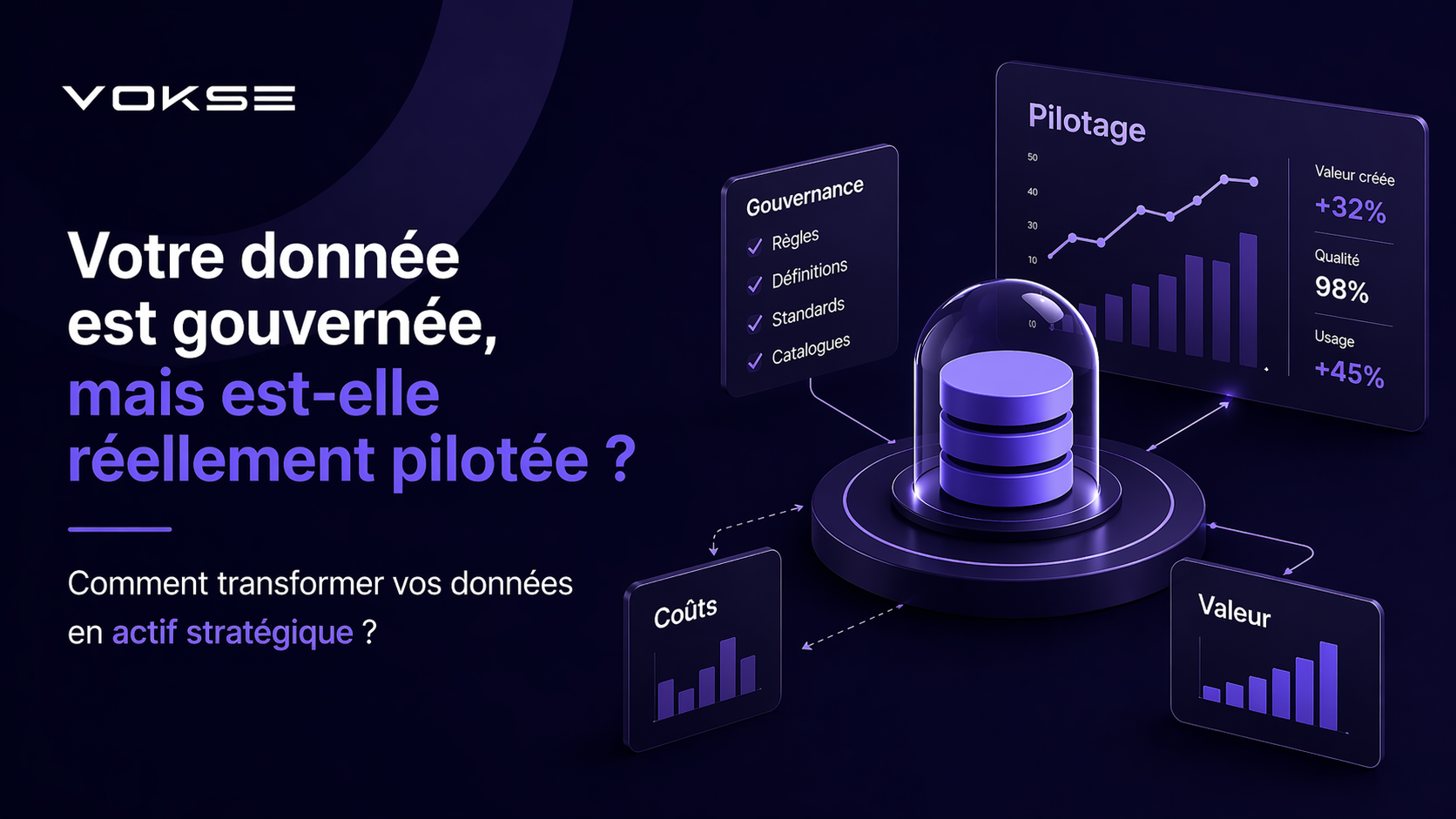
How do you turn your data into a strategic asset?
Data has been presented as a strategic asset for more than ten years. 80% of French companies have already written data into their strategic plan. Yet, despite massive investments in people and technology, many organizations fail to produce visible, measurable results.
The explanation is simple: unlike other assets (financial, industrial, etc.), data is treated as a documentary object rather than as an operable, decision-driving asset. Most companies think they are piloting their data. In reality, they are piloting tools, rules and definitions — but not the data itself. This gap creates a structural misalignment between IT, data and business teams.
In other words, data is often governed, but too rarely piloted. Yet a strategic asset should not merely exist or be documented. It must be measured, optimized and piloted over time to create value. In this article, you will discover how piloting turns data from a cost center into a profit center.
Governing data does not make it operable
Many companies confuse the concepts of data governance and data piloting. Yet they do not address the same need: governing data means defining a framework. Piloting an asset means deciding and acting within that framework.
Governance refers to the standards and processes that regulate the use of data in your company. It defines a framework for collection, storage, processing and data security. Governance does not act directly on the data itself, but on its metadata: catalogs, glossaries, rules, and so on.
By definition, governance is therefore passive. It formalizes and frames, but it does not make data operable. Governance is also asynchronous. It is validated at a point in time, while data and uses evolve continuously.
Governance tools were designed for a world where you documented to comply, where data served above all to explain what had already happened. Data was essentially descriptive, declarative and passive.
But that world has changed. Data flows in real time between applications. It is embedded in operational processes. It directly feeds commercial, marketing, financial and industrial decisions. Governance tools were designed for a world where you had to prove. Piloting answers a world where you have to act.
Piloting makes data actionable. It allows you to know, continuously:
- in which system the data lives,
- how it flows between your applications,
- how it is calculated and transformed throughout processing,
- what it means for the business and in what context it is used,
- whether it is reliable or not.
Piloting is synchronous and kept up to date automatically. If governance reflects the past, piloting prepares the future by leveraging data in real time. It connects data and metadata to technical flows, applications and business processes.
By adopting a piloting solution, your company no longer merely frames data passively — it can truly pilot its use and impact every day. Because data only has value when it acts.
Passive · Asynchronous · Descriptive
- Sets the standards and processes (collection, storage, security)
- Acts on metadata: catalogs, glossaries, rules
- Validated at a point in time, frozen while uses evolve
- Used to document and prove the past
Active · Synchronous · Actionable
- Locates data in every system and tracks its flow
- Traces calculations and transformations end to end
- Measures reliability in real time and detects anomalies
- Triggers action and decision at the right moment
Turning data into value
The absence of piloting shows up in several concrete symptoms:
- data is hard to find and reflects a past picture rather than the current reality,
- the same data point may exist in several copies, documented and updated manually,
- the reliability of data is regularly called into question and its impact on operations is not measured,
- it is hard to quickly trace a figure back to its origin and its transformations,
- a misalignment persists between data, IT and business teams.
In this situation, data is just a cost center. As a strategic asset, your data must produce real value by developing the ability to generate a measurable effect and a quantifiable impact on company performance. This value is both operational and decision-driving: to arbitrate more intelligently, execute more effectively, and continuously improve the company’s operations.
Value-bearing data is:
- Linked to a tangible outcome: a revenue figure, a rate, a variance, or a lead time.
- Tied to a clear use: what is it for, who uses it?
- A decision trigger: when the outcome degrades or an opportunity arises, it triggers an action — arbitrating stock, adjusting a price, launching a commercial campaign.
- Unambiguous: its calculation method and interpretation are shared across all employees. Everyone relies on a common language that leaves no room for ambiguity.
- Embedded in a process: you can orchestrate it, measure its impact, compare its evolution from one period to the next, and fix what degrades it.
- Available in real time: to make reliable decisions based on the current context and not on a snapshot of the past.
In short, if your company is a vehicle, governance is the highway code: it sets the rules and defines a framework. Piloting is the cockpit of your organization: it surfaces indicators in real time, flags variances, and lets you move toward your destination without losing your way along the route. This piloting is also the operational engine that brings governance to life and turns your data into a growth lever.
Piloting connects data to action — every indicator is alive, every variance triggers a decision.
Three use cases for data piloting
Making the Data Office’s job easier
Without piloting, your data team is on the back foot. It responds, often under pressure, to requests from the various departments that need specific data at a given moment. Very often, the time spent searching for and reconstructing data accounts for 50% of the Data Office’s working time.
When data is piloted, teams no longer spend their days searching, cross-checking, cleaning or maintaining documentation manually. Data is immediately available and activatable: the result is a considerable saving of time and energy. Employees can then focus on strategic projects and support the business in their use cases.
Boosting marketing campaign performance
21% of companies’ media budget is wasted because of poor data quality. An invalid email address, an incomplete name, an outdated professional situation… At the scale of a campaign, these anomalies degrade the reliability of KPIs such as deliverability rate or click-through rate. They spend your budget on poorly qualified segments. Targeting errors generate customer dissatisfaction and can damage your reputation.
A data piloting solution can automatically qualify the quality level of marketing data before the campaign is sent. It helps you detect and correct anomalies to make your marketing base reliable. By relying on complete and consistent data, your marketing team can personalize its communications more effectively. The performance of your campaigns then increases and generates substantial financial gains.
Automating KYC verification
In the financial sector, KYC (Know Your Customer) is a legal obligation that requires institutions to verify the identity of their customers and to carry out continuous monitoring to assess their risk level. There is no margin for error.
Without real-time data piloting, anomalies are discovered too late. The consequences are operational, with certain files being blocked. They are also regulatory: when data is incorrect and lacks traceability, it is difficult to prove to the regulator that controls were carried out correctly. There is therefore a direct risk of non-compliance and financial penalty.
Data piloting guarantees full control of KYC. It helps financial institutions quickly identify where KYC data is located, and detects anomalies in real time before a file is blocked. It also allows the compliance team to track the evolution of tangible indicators (completeness rate, number of anomalies, processing times, etc.) and to build a history of the controls performed in case of an audit. Finally, automating controls reduces dependence on manual checks and makes KYC reliable over time, even as data volumes and flows grow.
Conclusion
Piloting data is not about adding a layer of governance. It is about changing logic: connecting data to action, making its real status visible, and enabling arbitration at the moment decisions are made.
Piloting unlocks the potential of your data to turn it into a lever of operational performance, decision-making and growth. This piloting is only possible if it relies on a complete solution, genuinely capable of turning data into value.
Discover Vokse through an online demo and identify your maturity level as well as your organization’s priority actions.